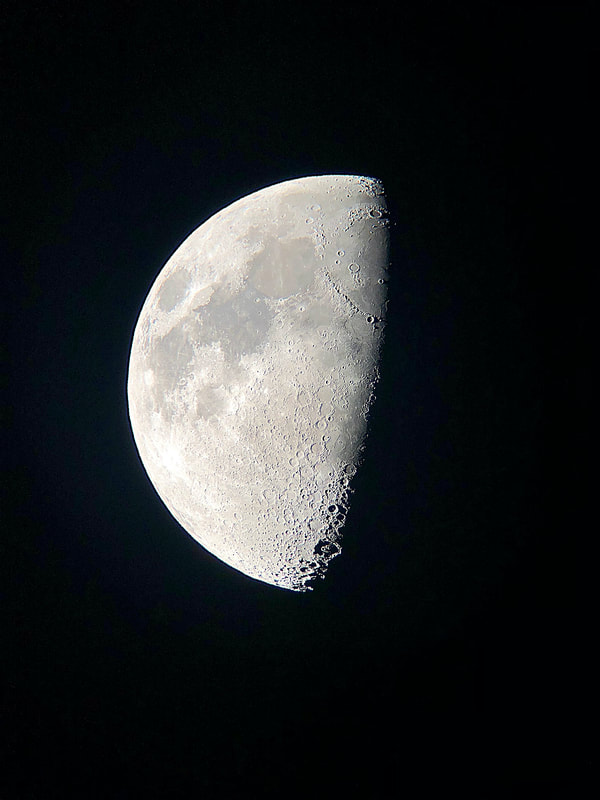
A beautiful sight, especially in better-than-average seeing.
Last night, miraculously, the clouds cleared rather than thickened after sunset, and seeing conditions lingered - for just an hour or two - near average. I dutifully set out with my Takahashi, yet when I reached the rooftop I found it crowded with people. It's like we, as a city and country, have simply decided to ignore COVID-19. Disappointed, I walked downstairs and decided to set up shop on a bench just outside my building. While I was tucked mostly out of sight, there were bright lamps everywhere, and so I had little choice but to observe the Moon. Not ideal, but not the worst: there are few better things to do than explore the half-full Moon with a fine refractor.
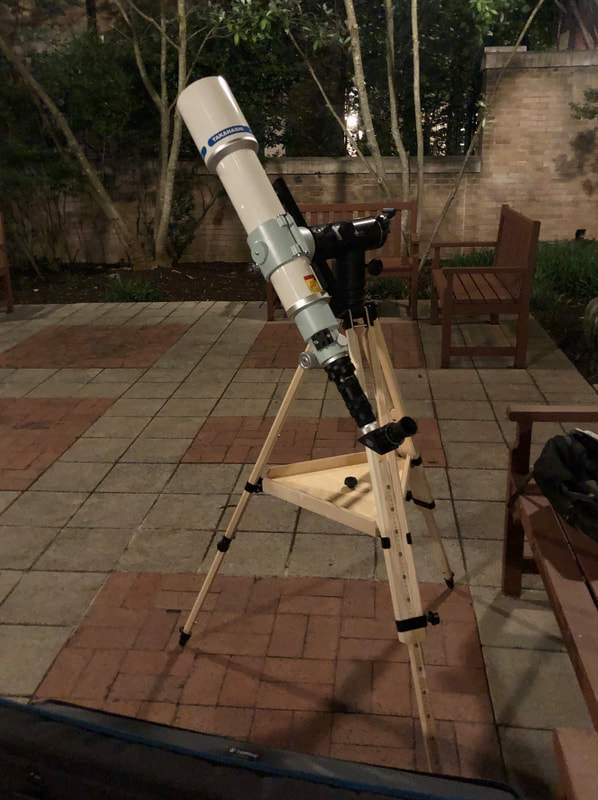
I resorted to this.
With the Moon at 60x, it was immediately obvious that it was going to be a special night. Maybe the seeing was supposed to be average overall, but the Moon seemed unusually sharp. Switching to around 200x, I could easily make out a number of craterlets within the crater Plato, and I was delighted to make out the towering shadows of its mountainous rim. Mountains on the Moon are rounded by years of bombardment, but they nevertheless cast spectacular shadows with the Sun at locally low elevation. These particular shadows, in Plato, have an especially interesting history. In the nineteenth century, observers announced that their flickering betrayed the existence of a lunar atmosphere. The apparent appearance and disappearance of those craterlets, meanwhile, supposedly revealed ongoing volcanism. Was the Moon an active world? To many of the era's leading Selenographers - geographers of the Moon - it certainly seemed to be.
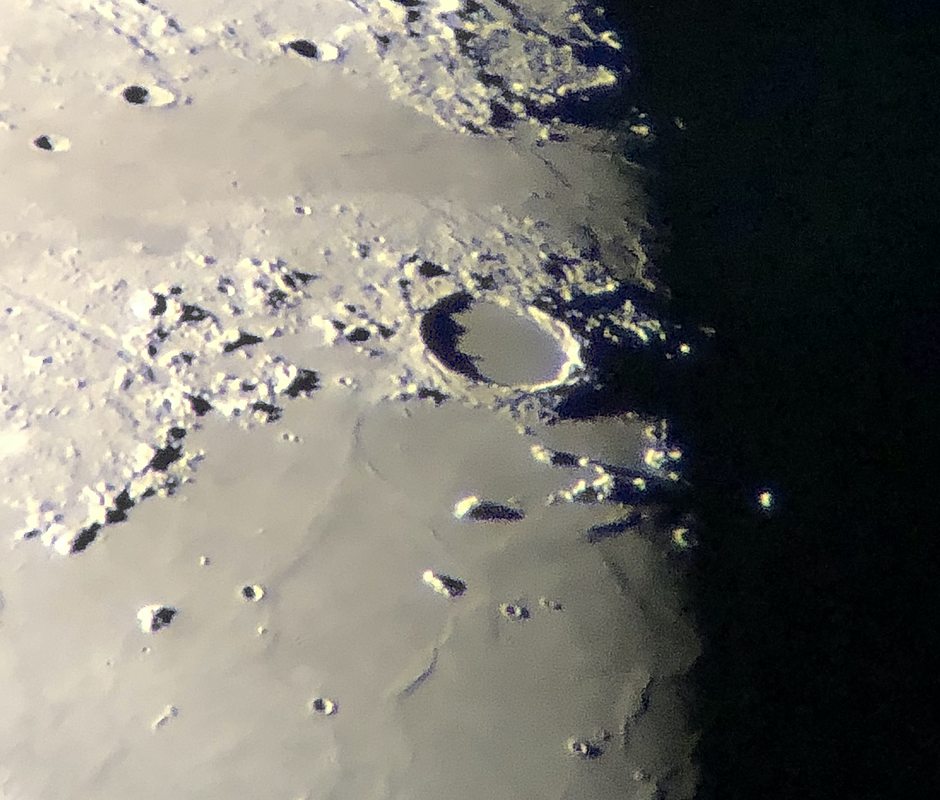
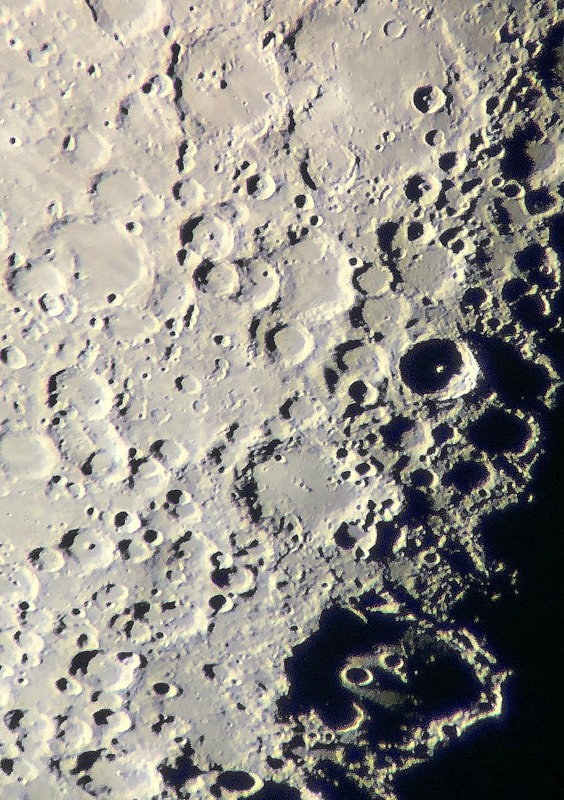
I maintain that this isn't bad, considering it was taken with an iPhone 8!
It was one of those nights where you could just linger endlessly over the minutest details on the lunar surface, exploring the complexities of terrain you've never really seen before. The Moon's mountain ranges, in particular, had a towering, three-dimensional feel to them. The glint of mountains catching the rising Sun in the blackness just beyond the terminator always gets me. I can just imagine what it would be like to stand on one of those peaks, taking it all in with the Earth overhead.
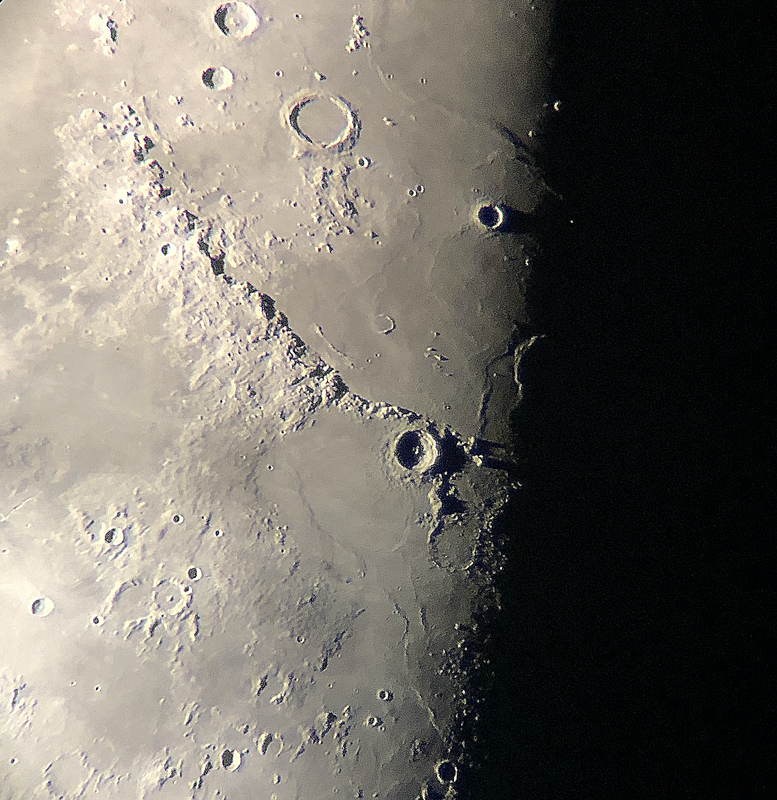
Surely one of the best lunar pictures I've taken with my iPhone.
Nearly as striking as the specular detail I could make out, however, was the chromatic aberration I could clearly see, despite using a telescope in the FC-100DC that is nearly free of color - and despite using a focal extender that should have all but eliminated false color. Stepping away from the eyepiece, I noticed that the Moon had a hazy look to it, with yellow distortion around the disk. Could the atmosphere be causing all that false color? Or was it stray light entering the optical tube? I'm still trying to figure it out - but it's definitely something I'll monitor.
Nevertheless, a memorable night - and not least for the wail of police sirens in the background, amid protests here in DC over yet another expression of racial injustice. At least there was the SpaceX launch, earlier in the day, to give us a measure of hope for the future.
Notes from readers